Public Draft page: This article has not yet been fully reviewed and may contain inaccuracies or incomplete information.
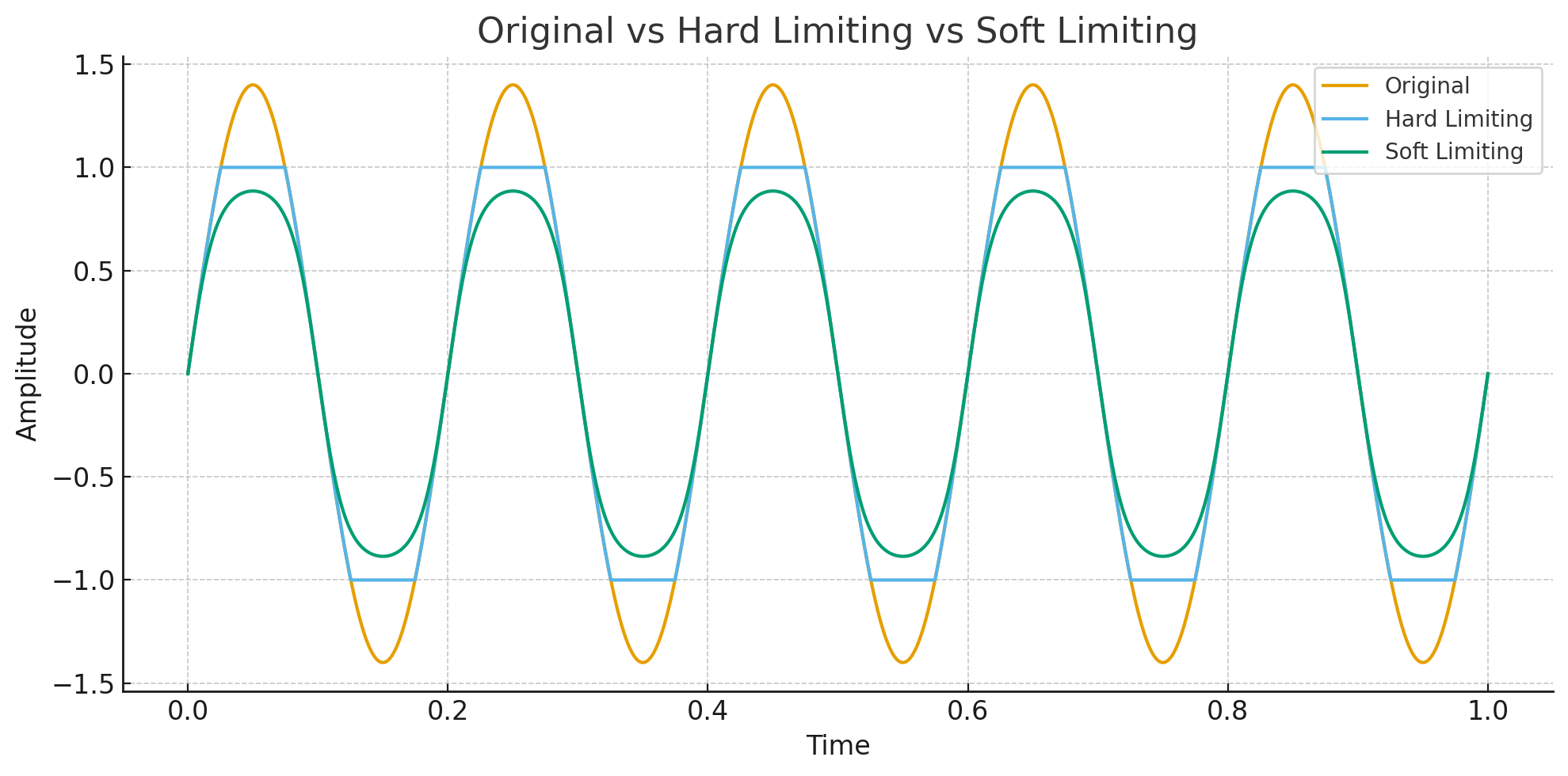
A limiter is a dynamics-processing device or algorithm that prevents the amplitude of an audio signal from exceeding a specified threshold. Signals with a level that is - at the input of the limiter - below the threshold are fed to the output of the limiter without any changes. However, signals that have a level above the threshold are attenuated by a very high or effectively infinite ratio such that at the output of the limiter, the signal level remains at the threshold level. The waveform of the signal is largely maintained. This creates a fixed maximum level (“ceiling”) and ensures reliable peak control, distinguishing limiting from clipping, the latter removing waveform peaks outright and thus introducing a change in wave shape and correspondingly stronger distortion.[MasteringBOX]
Function and Applications
In audio engineering, limiters are utilized both for protective and creative purposes. They are common as safety devices in live sound reinforcement and broadcast systems, where they stop sudden surges in volume (e.g. due to feedback or loud transients) from exceeding safe levels. By preventing signal spikes, limiters shield power amplifiers and loudspeakers from overload, unwanted distortion, or even damage. Professional sound equipment often has built-in limiters for this reason: for example, many bass guitar amplifiers and PA power amplifiers include limiter circuits to avoid clipping at the power stage and to protect speakers. In contrast, amplifiers for electric guitars typically omit limiters since guitar amps often embrace intentional distortion as part of their sound. In the context of audio mastering (the final stage of music production), limiters are used in conjunction with make-up gain to raise the overall loudness of a mix without causing (digital or analog) clipping. A mastering engineer will often apply a so-called brickwall limiter as the last processor in the signal chain to ensure that the recording achieves a competitive loudness level while strictly preventing any signal peaks from exceeding e.g. 0 dBFS (the maximum digital level).[Bob] When applied sensibly, this yields a louder, more polished track; however, overuse of limiting can lead to a squashed dynamic range or audible distortion - engineers must therefore strike a balance. Limiters also find use in broadcasting: radio stations employ aggressive multi-band compressors and limiters to conform to loudness regulations and prevent over-modulation. Limiters are used beyond audio engineering: for example, FM radio receivers typically include limiter stages that output a constant signal amplitude to the FM demodulator, improving noise performance and reducing the impact of interfering signals via the capture effect. In summary, limiters are indispensable tools for keeping signal peaks in check: they enhance safety and consistency in live and broadcast audio paths, and they enable greater loudness and impact in recorded audio when used judiciously.[Chee];[Audacity]
Principle of Operation
Basic mechanism
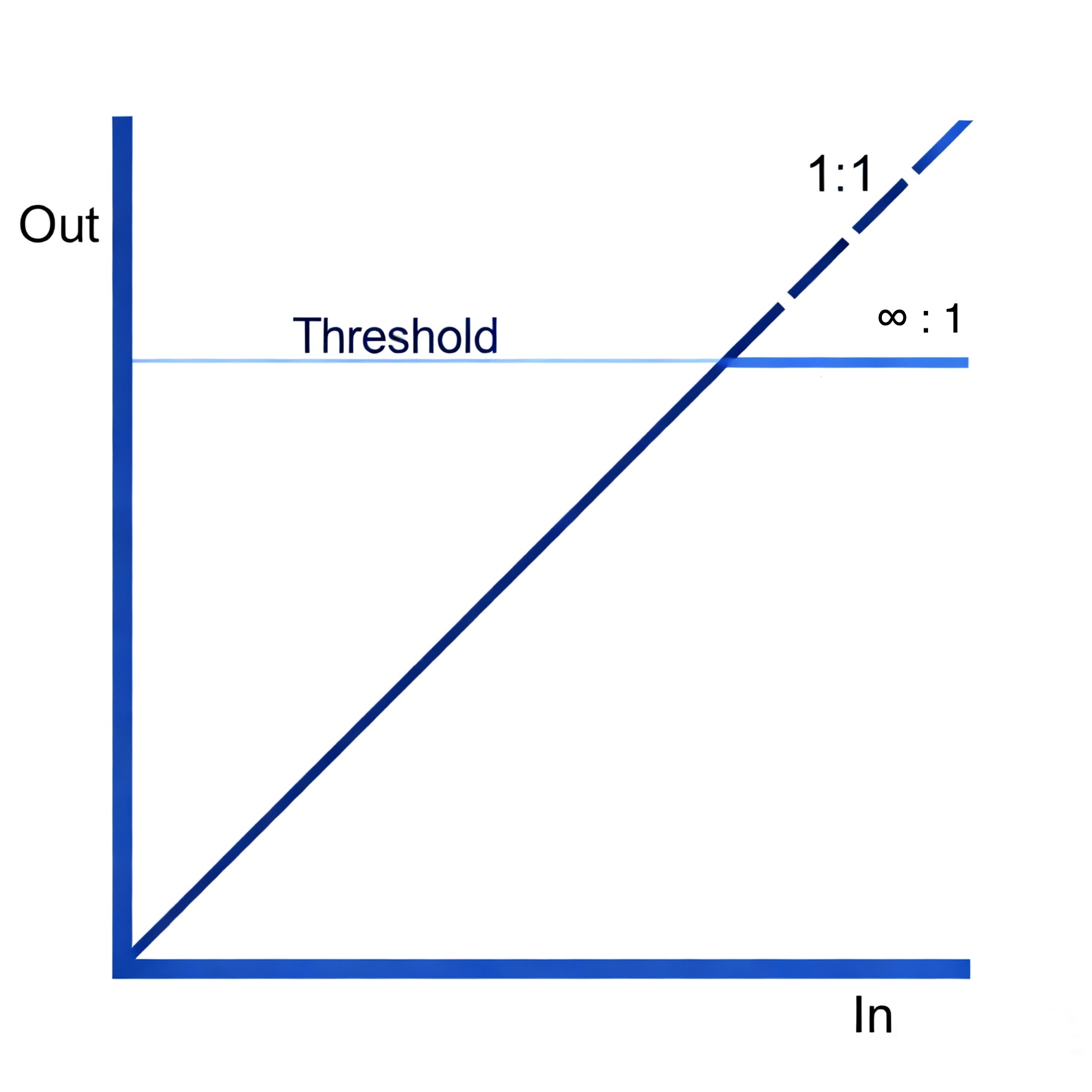
A limiter continuously monitors the audio level and reacts when the signal approaches or exceeds the predefined threshold (also called a ceiling). At the moment the input signal reaches the threshold, the limiter intervenes by reducing the gain so that the output of the limiter does not go any higher. In a hard limiter (brickwall limiter), this gain reduction happens very rapidly and with a high ratio, such that the output is effectively capped at the threshold level.
Mathematically, an ideal hard limiter can be described as: if x(t) is the input and T is the threshold, then the output:
y(t) = x(t) for x(t) ≤ T
but y(t) = T for x(t) > T
In practice, real limiters do not simply flat-clip the waveforms; instead, they dynamically adjust gain to prevent overshoot. For example, a feedback limiter might momentarily attenuate the gain by whatever amount is necessary (often within the order of milliseconds) to counteract an incoming peak, then restore the gain once the peak has passed.
Attack and release
Limiters are characterized by very fast attack times – the attack time is how quickly the limiter responds to an over-threshold condition. Most limiters engage almost instantaneously (i.e. the attack time is in the range of a few microseconds to 1 ms) to “catch” transient peaks before they overshoot. In modern digital implementations, a zero or near-zero attack time is often achieved by using a small look-ahead buffer: the audio is delayed internally so that the processor can begin attenuating already before an anticipated peak arrives at the output. This look-ahead technique ensures true brick-wall limiting with no overshoot, albeit at the cost of a slight delay (latency) in the signal path. The release time of a limiter determines how quickly it stops attenuating after the signal falls back below the threshold. A very fast release will restore the original gain almost immediately, which can potentially introduce distortion or a “buzz” on low-frequency content as the gain wavers rapidly. On the other hand, a very slow release will keep the gain reduced for a longer time, which avoids buzz but can lead to an audible pumping effect (the background sound swelling audibly after a loud section ends). Some advanced limiters offer an auto-release or adaptive mode, wherein the release time adjusts itself based on the input signal’s characteristics to minimise distortion and pumping.[MasteringBOX];[Audacity]
Circuit implementation
In analog electronics, limiters can be built using a variety of approaches. A simple method (for which the term "clipping" is in fact more applicable in connection to audio engineering) may use diode clipping: for example, a pair of diodes placed in an anti-parallel configuration between the signal line and ground will conduct (and thereby shunt excess wave-shape portions to ground) once the voltage exceeds the diodes’ forward voltage threshold. This effectively limits the peaks and forms a very rudimentary limiter that hard-clips the waveform to the diodes' voltage threshold. Such diode limiters are found in radio transmitters and receivers (to prevent overload from excessive signal or noise spikes), and as protective clamps in audio gear. However, such analog limiters that rely on device saturation (diodes, transistors, etc.) will introduce harmonic distortion when active - they do literally flatten the waveform peaks, after all. More refined analog limiters use actual signal-level detection and voltage-controlled amplifiers (VCA), optical elements (opto-electronic compressors), or FETs to smoothly adjust gain. This results in a softer limiting action with considerably less or even no harmonic distortion since the waveshape as such is almost completely maintained. However, analog limiters cannot look ahead (they only react after a peak has arrived), and therefore very fast transients may still partially slip through before the limiter becomes active. These “overshoots” are typically small, but their occurrence implies that analog limiters might allow occasional peaks of a few dB beyond the set threshold. Digital limiters, with look-ahead capability, eliminate this issue by design – ensuring 0 dBFS is never exceeded e.g. in a digital audio workstation or a broadcast chain.[Shorter]
Knee and ratio
Limiters can be designed with either a "hard knee" or "soft knee". A hard-knee limiter applies full limiting action immediately once the threshold is reached – in other words, its input/output curve has a sharp corner (knee) at the threshold. This is common for “brickwall” limiters that enforce an absolute ceiling. Some limiters, however, may use a soft knee or a progressive ratio increase near the threshold and therefore operate more as a compressor. In this case, the limiter begins to apply small amounts of compression as the audio signal approaches the threshold, reaching full limiting only as the signal becomes even stronger. This soft-knee approach (or a soft limiter setting) squashes peaks more gently and can make the limiting less apparent to the listener. In practice, the effects of an aggressively-set compressor on one hand, and a gently-set limiter on the other hand may not be very different at all. Typically, compression is thought of as reducing dynamic range by a moderate ratio (e.g. 2:1, 4:1 or 8:1) for artistic control (using the limiter or compressor more as a sound-effects device), whereas limiting implies a high ratio (10:1, 20:1, up to ∞:1) mainly to stop the signal from peaking any further. Some sources consider any compressor with a ratio of 10:1 or above to be acting as a limiter. The brickwall limiter is an extreme case with an effectively infinite ratio and instantaneous attack – yielding a near-absolute ceiling.
Limiters and related processes can be categorised by how severely they restrict the signal and how they treat the waveform when the threshold is exceeded.
Hard Limiting (Brickwall Limiting)
This refers to strict, high-ratio limiting that aggressively prevents the signal from exceeding the threshold. A hard limiter typically has a very high ratio (approaching infinity), a hard knee, and an instantaneous attack. Once the threshold is hit, the gain is reduced very quickly and by a large amount, such that output peaks do not go beyond the set point. The term brickwall limiter is often used for digital mastering limiters that absolutely ensure no sample exceeds 0 dBFS. Hard limiting, by design, alters the dynamics significantly – it can transparently control peaks if not triggered too often, but under heavy use it will impart a “flattened” dynamic profile to the sound. On the plus side, it offers maximum protection against overload. [Audacity]
Soft Limiting
This term is used for gentler limiting strategies that aim to rein in peaks with minimal side-effects. A soft limiter might employ a lower compression ratio (e.g. 5:1 or 8:1) just above the threshold, or use a soft knee curve, or slightly slower attack/release, so that the gain reduction is more gradual . The goal is to reduce the signal’s maximum level by some amount without the process being too audible. Soft limiting can preserve more of the signal’s natural dynamics and timbre, at the cost of allowing an occasional slight overshoot or not catching the absolute peak. This technique is useful when a transparent, inconspicuous result is more important than achieving the highest possible loudness. Some classic broadcast limiters and certain “levelling amplifiers” (like the LA-2A in limit mode) can be thought of as soft limiters – they control peaks, but do so gently.
It should be noted that these categories often overlap in practice. For instance, an analog limiter might soft-clip once pushed beyond its control range, or a digital brickwall limiter might have a switchable soft-clip option at the very top. Audio engineers choose the type of limiting based on the context: transparent limiting (minimal audible artifacts) is desired in mastering and live protection, whereas creative limiting or deliberate clipping may be used as an effect in sound design.[Audacity]
MasteringBOX – “What is a Limiter in Audio? When & How to Use in Mastering”. MasteringBOX Blog, 19 July 2018. An educational article explaining the function of limiters in plain terms.
Audacity Manual – “Limiter” (Effect Documentation). Audacity Team (2025). Audacity Development Manual.
Chee, Eric – “Basic Sound System Design”. IVA (Audio Processor Resources), IVA Workshop series, circa 2019.
Bob Katz (2015). Mastering Audio: the art and science (3rd ed.). Focal Press. p. 81. ISBN 978-0-240-81896-2.
Shorter, D. E. L.; Manson, W. I.; Stebbings, D. W. (1967). The Dynamic Characteristics of Limiters for Sound Programme Circuits. Research Report No. EL-5. British Broadcasting Corporation Engineering Division Research Department. Available at: https://downloads.bbc.co.uk/rd/pubs/reports/1967-13.pdf.